

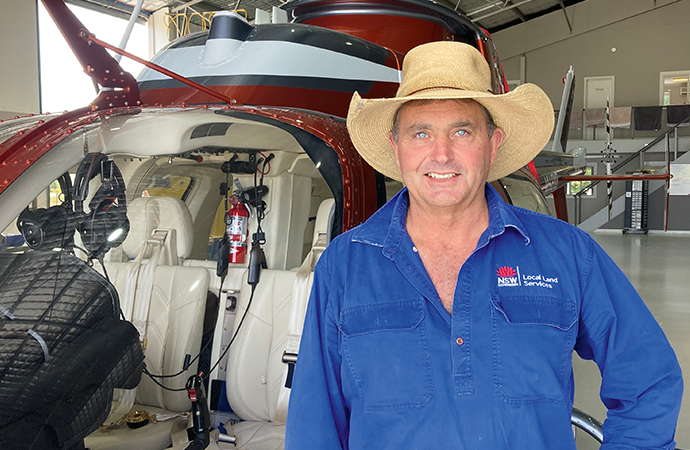
Meet one of the Champions of the State keeping feral animal numbers down.
Mal Leeson and his colleagues at Local Land Services are at the frontline of a war against an exploding population of feral animals.
“Feral pigs cause extensive damage to both agriculture and the environment by uprooting crops, degrading pasture, and destabilising soils through their digging and wallowing behaviour, which leads to erosion and reduced water quality,” he said. “They also prey on native wildlife, destroy vegetation, and spread invasive weeds, significantly impacting biodiversity and habitat health.
“In agricultural regions, feral pigs inflict major economic losses. They cost more than $100 million annually across Australia by destroying crops, fouling waterways, and even preying on livestock. Importantly, they act as reservoirs and vectors for serious diseases, including leptospirosis, brucellosis, African swine fever, and foot‑and‑mouth disease, posing risks to livestock, wildlife, and biosecurity.”
The NSW Government’s eradication program has dispatched 223,000 feral pigs over the past three years. However, according to the Federal Government’s National Feral Pig Coordinator, Bec Grey, about 100 million feral pigs are running wild throughout the country. Therefore there is plenty of work still to be done.
Local Land Services works with landholders to control feral animals.
“Methods which landholders can undertake to control feral pig numbers include poisoning, trapping, ground shooting, aerial shooting, and exclusion fencing,” said Mr Leeson. “The critical part of any control program is to reduce the population to a level which places downward pressure on the density and distribution of the pest. Feral pigs are prolific breeders; therefore, any control strategy must reduce the entire population by around 80 per cent to achieve downward pressure on numbers.
“Any less, the population will increase over the next 12 months. Aerial shooting is arguably the only control option with the capacity to reduce the population at scale in the shortest possible time with the least disruption to farming and grazing operations.”
Aerial shooting may cull pig numbers, but it also attracts critics.
“Our aerial shooting programs attract a lot of scrutiny from the general public and the hunting fraternity,” said Mr Leeson. “Social media seems to be the most popular method of venting frustration.
“We get called all sorts of names, but it doesn’t bother me. I have been aerial shooting for 27 years and have always maintained a focus on humane destruction and safety. Negative commentary comes from a lack of understanding and acceptance of aerial shooting as an efficient control.”
Local Land Services is also responsible for controlling other species, such as foxes, wild dogs and the state’s rapidly increasing deer population.
For Mr Leeson, typically no two workdays are the same.
“I work in the Invasive Species Team supporting the Principal Program Manager – Biosecurity,” he said. “I coordinate many projects related to vertebrate pesticides, firearms, and aviation. This includes training to enable staff to maintain required accreditations and providing assistance to regions during aerial and ground-based control programs.
“I do my fair share travel which I enjoy as it provides an opportunity to network and to put a face to names that you see on the many online meetings. I deliver various training courses in pesticides, firearms and aerial shooting and this has proved to be a great way to meet new staff and share my experiences.”
Mr Leeson has taken a varied career path to reach his present role and his position with the union.
“My first experience in a semi-government role was when I started as a noxious animal inspector with the Rural Lands Protection Board in 1994,” he said. “The role was mostly regulatory and focused on carrying out property inspections to ensure land managers were suppressing pest populations.
“In 1996, I became the secretary of the Rangers and Noxious Animal Inspectors Association, working closely with the PSA to plan and run the Annual Conference. I held this position for about 14 years before taking on the President’s role for a few years.
“Since 2016 I have maintained a position on the Departmental Committee and represented the PSA at Joint Consultative Committees.”





 The Public Service Association of NSW and Community and Public Sector Union (SPSF Group) NSW Branch acknowledges the Traditional Custodians of the lands where we work and the places in which we live. We pay respect to Ancestors and Elders, past, present and future. We recognise the unique cultural and spiritual relationship and celebrate the contributions of first nations peoples to Australia.