




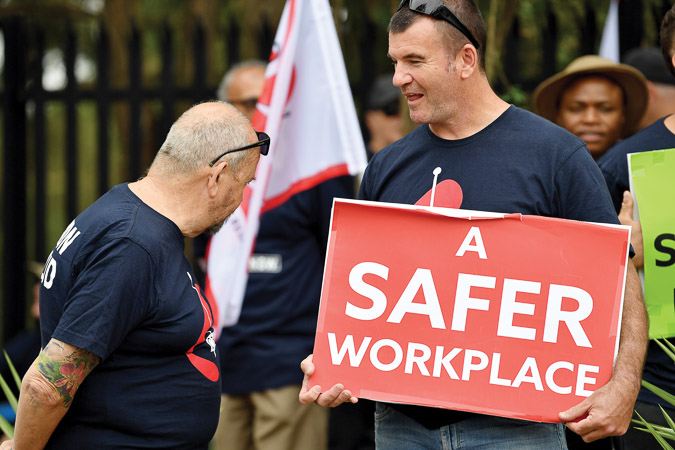
As another private prison goes into state hands, Red Tape looks back at a sell-off gone bad.
In October 2026, Parklea Correctional Centre returned to public hands, ending 17 years of private operation.
This is the result of relentless campaignng by the CPSU NSW, with General Secretary Stewart Little taking up the issue with senior figures in the NSW Government, including Premier Chris Minns.
In 1979, the NSW Government bought a parcel of land from the City of Blacktown for the purpose of building a metropolitan maximum security prison, one that was proclaimed on 19 October 1983.
The prison was the product of a penal philosophy emerging from the Nagle Royal Commission, which brought sweeping changes to the Department, seeing it transition from ‘the Department of Prisons’ to ‘Corrective Services’.
Before the Nagle Report was even published, the Labor Wran government sacked the Commissioner of Corrective Services Walter McGeechan in January 1978. When the report was published two months later Mr McGeechan’s sacking was one of the 250 recommendations. His replacement, and the person given the task of implementing the Nagle Report’s recommendations was social reformer and academic Tony Vinson, who had worked in the department for many years.
Several of the Nagle report’s recommendations were favourable to PSA members, such as better salaries and increased consultation between the union and the department, and the establishment of a new gaol at Parklea.
However, Parklea Prison, later named Parklea Correctional Centre in 1992, has had a chequered history of stabbings, jailbreaks and a spate of scandals; particularly since its privatisation in 2009 by a Labor Government. US-owned operator GEO Group Australia undertook the first private contract in 2009; and after a parliamentary inquiry found serious and systemic problems, MTC Australia took over in 2019.
GEO Group Australia lost its contract to run Parklea following severe security failures and public scandals. Significant quantities of smuggled contraband, weapons, mobile phones, and missing keys were just some of the critical operational issues exposed. High-profile incidents such as an inmate posting a video on YouTube in 2017 wielding a knife and boasting about drugs, as well as stabbings and cell fires broke government confidence in GEO Group’s management and revealed that the company failed to fulfil its key contractual obligations regarding safety and order.
Swapping out one private operator for another did not help. Under MTC Australia a contraband smuggling operation was operating, while a 33-year-old detainee was stabbed to death by a fellow prisoner, both incidents taking place in 2020. The following year poor security and operational issues only escalated. A 41-year-old inmate died within 24 hours of being released from the prison in an epileptic seizure in public. His family alleged it was due to him not getting access to medication while on remand in the facility. Later the same year, more than 40 prisoners took part in a rampage scaling the roof and torching parts of the facility, causing $8 million worth of damage.
“Private companies are trying to make money, and the way they do that with prisons is by cutting staff, paying them less and working them longer,” Stewart Little, General Secretary of the PSA CPSU NSW said. “It results in fewer staff on the ground, inmates spending longer inside cells and having less time having a structured day or being rehabilitated because they’re locked in. It is also part of the reason for the increased violence like the deaths in custody, increases in assaults, both assaults on our members, the officers and inmates to each other.”
Following the transition of Junee Gaol to public hands in 2025, Parklea was next in the queue in the recovery from the state’s failed private-prison experiment.
“Privatisation hurts everyone. When you’ve got key government areas like law and order or providing wellbeing for children, that’s a public sector responsibility of the government. You should not look to outsource that and outsource your responsibility,” said Mr Little.








 The Public Service Association of NSW and Community and Public Sector Union (SPSF Group) NSW Branch acknowledges the Traditional Custodians of the lands where we work and the places in which we live. We pay respect to Ancestors and Elders, past, present and future. We recognise the unique cultural and spiritual relationship and celebrate the contributions of first nations peoples to Australia.

Leave a Comment
Your email address will not be published. Required fields are marked with *