

Neglecting higher learning will come at a high cost for the country.
Tiffany Bett is working towards a healthier future for NSW. “I am the Rural Clinical School Officer in the Graduate School of Medicine based at the University of Wollongong’s [UOW’s] Shoalhaven Campus in Nowra,” she said. “My role entails supporting the medical students in our leading rural medical school.
“We are a part of a thriving medical school, which also makes things a little easier, more positive, and more proactive than other areas of the organisation.”
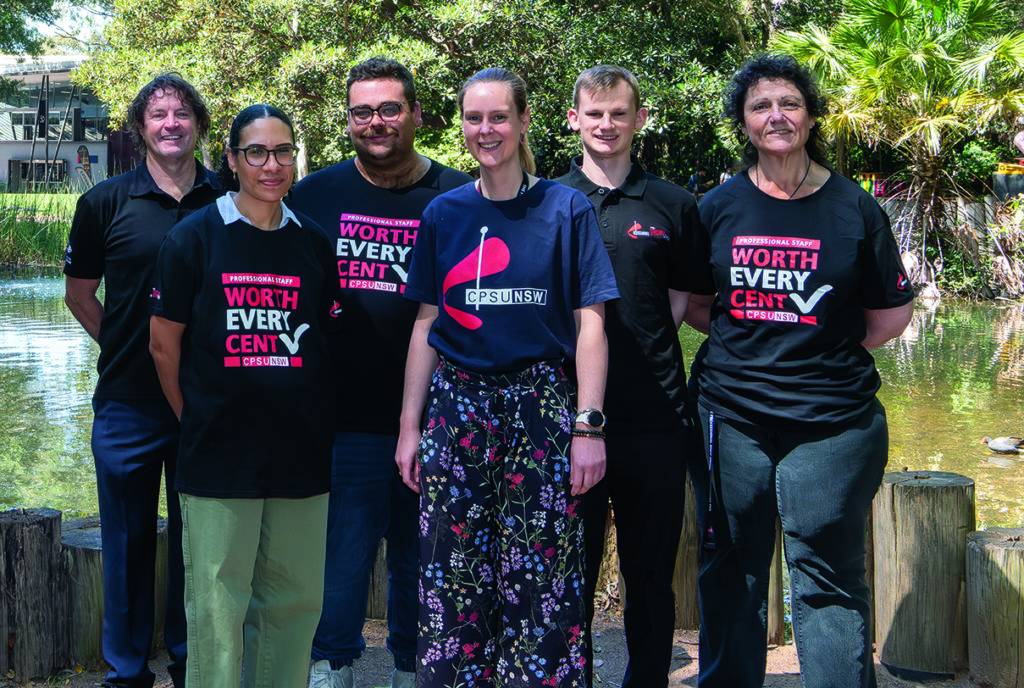
Ms Bett is among the army of Professional Staff working in NSW’s world-class university sector.
“Professional Staff across the 11 public universities in our state are an important part of the CPSU NSW membership,” said General Secretary Stewart Little. “They not only support teaching and research and development, they are part of Australia’s largest services-based export, thanks to the large number of overseas students who choose to study in NSW.
“But, as their union, we are witnessing wholesale job cuts on many campuses, putting at risk export dollars and the important research and development required for the future of the nation.”
UOW is among the worst hit by the cuts, with about 200 jobs slated to go.
“This is despite numerous suggestions on where money is being wasted in the organisation, like the ongoing engagement of contractors earning obscene amounts for not delivering projects, or paying multiple licences for duplicate IT services, or actively planning a fit for purpose, agile workforce and improving operational efficiencies,” said Ms Bett. “But sadly it comes down to the fact they don’t value their biggest asset: their people. The people who give so much to making sure the place runs and students are taught.”
PSA CPSU NSW Regional Organiser Bart McKenzie visits sites from Wollongong to the Victorian border. However, UOW has a special place in his heart, as he has been both a student and employee there before working for the union.
“You notice the staff cuts and you see the syllabuses cut, but the big change I have noticed in my time in and around the university is its change from a learning institution to a for-profit organisation,” he said. “Liberal arts and courses involving critical thinking are the things they seem to cut.
“I can remember protests to stop the university from cutting a course on Aboriginal health.
“It is not a good look for an institution of learning.”
UOW has recently accepted funding from the conservative-leaning Ramsay Centre for Western Civilisation to increase its range of liberal arts courses over the next five years. While the funding has been welcome, there have been critics of the centre’s “Eurocentric” philosophy.
At the University of Technology Sydney (UTS), courses have been slashed and about 400 jobs were at risk as Vice-Chancellor Andrew Parfitt embarked on a cost-cutting restructure to delivered a $94 million surplus and $266 million in cash in 2029. However, UTS has since walked back from some cuts to jobs and courses.
“Over the past month, several staff members have approached me expressing frustration and concern about the lack of transparency regarding proposed changes to certain roles at UTS,” said Administration Officer within UTS Property and Delegate Fleur Sargent. “Despite multiple town hall meetings, many employees remained uncertain about their job security until just a few weeks ago.
“Now that updates have been provided, it’s clear that a number of colleagues are facing difficult outcomes. Some are required to re-apply for their current roles, others have had their positions made redundant, and several are being asked to take on additional responsibilities without any increase in compensation.”
At the University of NSW, Branch President and Vice-President of the PSA CPSU NSW, Shelley Odewahn, said jobs are on the line due to a “lazy, short-sighted strategy” from management.
“Universities do have alternatives,” she said. “Stop outsourcing and reduce reliance on consultants. The sector spends millions on consultancy firms for work that could and should be done in-house by staff who understand the institution.
“Professional Staff are cut while senior executive teams expand. This creates bloated structures and removes the people who deliver actual services.
“Universities need transparent, evidence-based decision making rather than crisis responses driven by short term budget pressures.”
Universities in regional centres are also facing cuts.
“Charles Sturt University [CSU] now finds itself in another cycle of restructuring, cost cutting and job losses,” said Strategic Project Officer in the university’s Faculty of Science and Health, Andrew Cox. “It is disappointing to see that we embarked on this same process only five years ago yet none of the lessons have been learned from back then.
“As usual it will be the staff, mainly Professional, who have to pay the price through job losses for the current situation. The knock-on effect of this can be devastating for families and the community especially considering nearly all households need two incomes to survive these days.”
Mr Cox, who is CPSU NSW Branch President at CSU, said the cuts will also affect regional communities that host campuses.
“Regional universities are very important to local communities especially cities like Wagga, Bathurst, Albury, Orange and Dubbo,” he said. “CSU employs around 2700 permanent staff across its footprint in addition to the thousands of students on campus and online. “The financial benefit is enormous.”
A 2020 report by the Regional Universities Network found “member universities contributed $2.4bn to their regional economies and created 11,300 jobs”.
The report found the non-metropolitan universities “increase the productivity of regional labour markets” and produced graduates more likely to remain in the bush, providing often sorely needed professional services.
A recent Australian Senate interim report criticised the way universities are run, finding there was a lack of transparency, accountability, and a disconnect between leadership and staff and students. It said universities need to look to get a better level of staff and student representation on university councils, and stronger powers for the sector’s regulator.
It also criticised excessive executive salaries of senior executives and vice-chancellors, with the average exceeding $1 million a year. The report recommended a remuneration tribunal for vice-chancellors. Other findings included excessive spending on consultants and a rise in senior management roles compared to the support staff now at risk of being fired.
There are concerns about the transparency of university councils and finances, including spending on consultants, with some concerns about potential conflicts of interest from senior executives moving between universities and consulting firms.
“There has been a reduction in consultants used here,” said CPSU NSW Delegate Luke Davis, who is Manager Timetables, Progression and Scholarships at Southern Cross University (SCU). “However, it’s difficult to gauge the spending in the financial reports.”
Among the Senate report’s recommendations is that universities in Australia publicly disclose “details of all spending on consultants, including the purpose of each consultancy and the extent to which the capacity exists to perform that function within the institution”.
At Western Sydney University (WSU), leaked documents revealed it was paying consultants eye-watering fees, with at least seven senior consultants raking in between $1325 and $2850 a day.
A consultant billed WSU $85,000 for just over five weeks’ work at a rate of almost $3000 a day. On top of that, the university was billed an extra $355 for “tolls and parking”.
There was a significant increase in senior and middle management positions, while support staff numbers declined between 1997 and 2017.
At UTS, 15 new laptops were purchased for consultants working on its $100 million cost-cutting program, sending what the Australian Financial Review described as “the worst possible message to the 400 staff about to get sacked”, particularly as there was an adequate supply of computers available.
Consultant KPMG was reportedly paid $7 million by UTS to advise how to cut staff numbers. UTS also spent $13.5 million on its ServiceConnect software rollout. This is far more than a similar rollout performed by Western Sydney University, with UTS’s end product failing to meet expectations.
“Recent media coverage has caused considerable concern among many UTS staff,” said Ms Sargent. “It reflects poorly on the university to see significant funds allocated to overseas travel for the Vice-Chancellor and senior executives, including expenses for flights, accommodation, and high-end dining, while frontline employees are being asked to tighten budgets for day-to-day operations.
“This sentiment extends to the use of external consultants, as it’s likely that internal UTS staff possess the expertise to produce similar reports at a much lower cost.”
Not all universities are being hit with job and budget cuts the same way. University of Newcastle Delegate Shell Dillon admits her employer “came out luckier than most other universities – for now”.
Ms Dillon is a Sterilisation Technician for the university’s Oral Health Therapy Program, which, in addition to research, operates a 17-chair clinic that can be accessed by the public, making it an important part of Newcastle’s health sector.
“The university is a huge part of the city,” she said. “If we were to lose it, there would be a massive gap.”
Ms Dillon said while the university has been spared the mass job cuts felt elsewhere in the state, there have been schools that have been harder hit than others.
“Engineering lost a lot of jobs,” she said. “They really copped it.”
She said while job cuts in the university have mainly been soaked up by people taking early redundancies, she worries there is more cost-cutting to come.
“These changes will be ongoing,” she said.
In Armidale, the University of New England has no cuts planned, other than the end of some fixed-term contracts in Payroll.
A staff member at the University told Red Tape the CPSU NSW is in “close consultation” with university management about the way it communicates with staff over uncertainty in the industry.
“We don’t want staff stressed,” said the employee.
Jeremy Cullis, a Librarian at Macquarie University, has seen up close the effects of restructures, having been cut from his previous job at Sydney University several years ago. However, he said there seem to be no cuts planned at Macquarie at present.
“We went through a big restructure in 2023-24,” he said. “They did an academic restructure first, then a professional staff restructure.
“Nothing is being done at present professional staff-wise. Management is happy with staffing.
“In a nutshell, we’re in a better place at the moment than other universities, such as Wollongong or Western Sydney.”
However, since the previous cuts there has been a hiring freeze at Macquarie. Mr Cullis admits this may create issues as jobs are not filled when staff retire or move to different employers.
The architect of the review that cut jobs at Macquarie, Nicole Gower, is now at the University of Sydney preparing a “professional services review”.
University of Sydney Branch President Grant Wheeler said while “we might be relatively safe compared to others”, he is worried Ms Gower has already planned to cut staff before even beginning her review.

“The whole thing is prejudiced before it starts,” he said, pointing to statements from Ms Gower pre-empting plans to shed staff.
He said this will adversely affect the mental health of staff already struggling to cope with workload.
“The University of Sydney already ranks poorly in student experience,” he said. “Cuts to Professional Staff will be a determined act of vandalism.”
If implemented, the job cuts at Sydney will take place at a time when the university is in a strong financial position. As student numbers drop elsewhere, Sydney University has admitted an extra 10,000 international students since 2019, who each pay up to $50,000 per year for their courses. The university posted a $545 million surplus last year and is reported to have nearly $10 billion in assets.
The CPSU NSW is fighting the cuts that are decimating much of the sector.
“Industrially, we’re challenging cuts through formal consultation processes, closely scrutinising business cases, demanding transparent evidence, and calling out decisions that lack proper governance or breach enterprise agreements,” said Ms Odewahn. “Politically, we’re meeting with federal and state MPs and advocating for funding reforms and stronger oversight of university decision-making.
“Collectively, we’re organising members, increasing visibility on campuses, and ensuring that Professional Staff are placed front and centre. Individually, we’re supporting members through redeployment, redundancy, and unfair processes, providing representation, advice, and advocacy to ensure no-one faces job loss alone.
“The union’s message is clear: cuts are not inevitable, and universities are stronger when Professional Staff are respected, resourced, and retained.”
There have been some successes. Scott Pendlebury, Chair of the CPSU NSW’s Western Sydney University Branch points to figures showing that, after negotiations with the union, university management has assured staff there will be no involuntary job losses.
The CPSU NSW’s Higher Education Representative Council (HERC) took a trip to Canberra to meet politicians such as Education Minister Jason Clare to demand the broken funding model be fixed.

“Our visit to Canberra was about ensuring that the voices of Professional Staff, the people who keep universities running, are heard at the highest levels of government,” said Ms Odewahn. “We met with MPs to discuss the wave of job cuts sweeping NSW universities, the growing dependence on insecure work, and the impact of chronic underfunding.
“We made it clear that universities cannot meet the goals of the Australian Universities Accord while simultaneously shedding more than 1000 Professional Staff. We raised serious concerns about poor governance, the lack of transparency around workforce planning, and the alarming overuse of consultants.
“We also pushed for stronger protections for regional campuses, better oversight of university councils, and a renewed commitment to public investment in higher education. The meetings were constructive, direct, and grounded in real stories from our members.”
Also in attendance was CPSU NSW Industrial Officer Mike Galvez.
“Jason Clare gave us more time than we initially were scheduled in with him for,” said Mr Galvez. “He was engaged and showed particular interest in the issues we raised regarding UTS and the reasons they have given for why they need to undertake such massive changes, as well as Charles Sturt.
“He sought data and figures from his staffer to back his points after the formal meeting in informal conversations with delegates.”
The HERC delegation also received a visit from Michael McCormack, who leads the Nationals, a party not noted for its friendliness with the union movement.
“It was surprising from the beginning when Michael showed up early while we were still meeting with Jason Clare and was then invited to sit in our meeting with the Minister,” said Mr Galvez. “Michael was candid and expressed keen support for Charles Sturt University.
“We met with Sharon Claydon, who is the Member for Newcastle, and Alison Byrnes, whose seat of Cunningham includes Wollongong. We talked to them about the respective universities within their areas, highlighting their importance as the go-betweens of State and Federal government in reminding them of the critical importance of these regional universities to their electorate and to their communities.
“We also met with Anne Stanley, the member for Werriwa, who was the MP who officially hosted us at Parliament House.”
Assistant General Secretary Troy Wright was also in the capital to meet Mr Clare.
“Canberra holds the purse strings and develops the National Skills Strategy and migration policies,” he said. “They influence drivers of the higher education space. However, they seem to delegate this responsibility to State Government, purely because these universities are enacted under state legislation.
“This tension currently exists and needs to be resolved by reminding Canberra that they are the main actors with respect to funding and regulation of the higher education space in Australia.”
Many of the CPSU NSW members interviewed by Red Tape say the job cuts would not take place if urgent attention was given to the funding model for the university sector.
“It needs to change so that universities can continue to deliver quality education, and everyone has a chance to access it,” said UOW’s Ms Bett. “The Government does not invest enough in higher education to make it a functional, sustainable and productive ecosystem that benefits the people, the region, the country and the world.
“The Government should invest more in Research and Development for Australia, and what better way to do that than through our higher education institutions where research is core business? This would be a win-win for the higher education sector and government priorities, working together to better tackle the challenges of our time.
“It would also be beneficial if the government heavily taxed big polluting organisations for damaging our precious world, and the money raised went into subsidising education for our citizens, so it is more accessible to everyone.”
Ms Bett agrees the sector has become over-reliant on fee-paying students from abroad.
“It is a product of the policy environment we operate in,” she said. “Universities have been forced to rely on international students because we have had to adapt to a flawed system and unsupportive policies.
“Income from international students was the means to survive when the government failed to provide funding to operate and thrive. If the government invested more in higher education and did not impose ridiculously limiting policies that don’t actually achieve their desired outcomes, maybe this would change.”
Ms Odewahn at UNSW said the focus on enrolling overseas students has changed higher learning in Australia.
“Over the years I’ve seen universities shift from being public institutions centred on education, research, and community service to organisations increasingly driven by market logics,” she said. “Because successive governments have systematically defunded higher education, public universities have been pushed to behave like private businesses, required to compete, commercialise, and generate their own revenue just to maintain core operations.
“International student fees filled the gap left by decades of declining public investment. This wasn’t an accident, it was a policy direction. Universities were told to grow international enrolments and many built entire financial models around that income. But this dependence creates enormous vulnerability. When borders close or geopolitical conditions shift, universities respond not by rethinking the model but by cutting the very people who deliver education and support to students.
“We should never have allowed public education to become reliant on an unpredictable global market to fund essential staffing.”
Facilities Officer at the Australian Catholic University, Richard Faulkner, said his institution had already seen cuts due to a “COVID budget plan” that saw dozens of roles eliminated.
“There needs to be a good look at curriculum, courses that are offered and research areas,” he said. “We also need to better cater to special-needs students.”
SCU’s Luke Davis said courses producing essential workers need to be more affordable.
“Core degrees like Nursing, and Secondary and Primary Teaching should be fee-free provided the graduate works for the public sector for a certain time,” he said, adding universities need to spend more on their core functions. “The funding needs to be better allocated to fundamental practices like teaching and research. The amount spent on events and conferences for networking, research and training could be scaled back significantly.”
At CSU, Andrew Cox said his university has specific needs that need more funding.
“Regional universities are underfunded especially when you look at the programs we need to run for students from low socioeconomic backgrounds and are first in the family to attend tertiary education and the fact we have multiple campuses,” he said.
“CSU has worked within its funding and budget for 25 years, but like many universities became reliant on international student income when it was only meant to be supplementary. Now that landscape has changed and because CSU isn’t receiving the critical mass of international students that was budgeted for, the organisation finds itself in financial difficulty.
“Senior Management needs to take real responsibility for this situation. The responsibility for good fiscal management lies with the organisation’s senior management.”
CPSU NSW General Secretary and Federal Secretary of the CPSU SPSF, Stewart Little said it is up to the Federal Government to return the tertiary education sector “to a place where learning is prioritised over earning”.
He added “Professional Staff matter” and the services they provide are vital if universities are to produce world-class research and education.
“In many cases, these universities were gazetted as places to provide education to the people of NSW, not a business opportunity for executives,” he said.
“The COVID-19 pandemic showed that depending too much on overseas students leaves the sector vulnerable to changes beyond its control. A greater focus on learning and research, and a stable business model, is only possible if the Federal Government, and to a lesser extent the State Government, provide more funding.”
The 2025 federal election featured commitments from both parties to drop overseas student numbers as a measure to reduce rising housing costs. However, the sharp cuts never eventuated and, in Sydney University’s case at least, international student numbers went up.
“This means our universities can no longer claim their export-driven model is the reason they need to cut jobs,” said Mr Little. “Australia’s university sector has assets in excess of $100 billion.
“Our universities are the envy of the world. Let’s keep it that way by ensuring the Professional Staff so vital to the student experience are kept in employment, supporting our universities.
“We know Professional Staff matter. It’s time management acknowledged this, too.”










 The Public Service Association of NSW and Community and Public Sector Union (SPSF Group) NSW Branch acknowledges the Traditional Custodians of the lands where we work and the places in which we live. We pay respect to Ancestors and Elders, past, present and future. We recognise the unique cultural and spiritual relationship and celebrate the contributions of first nations peoples to Australia.